
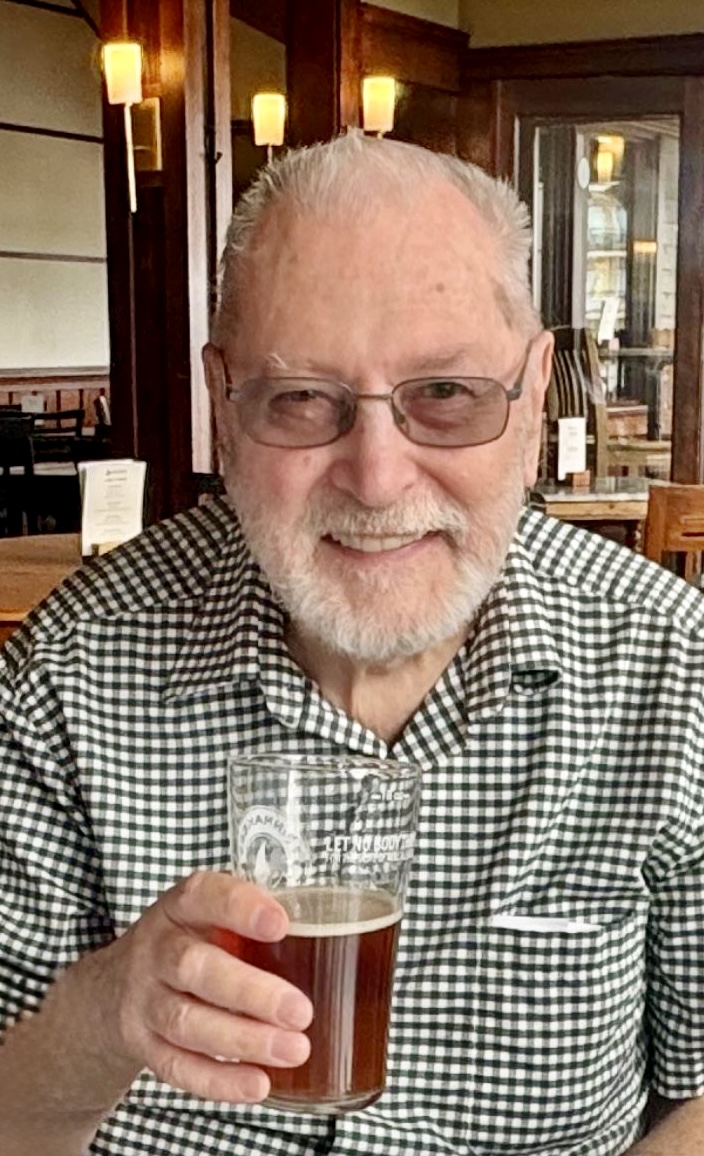
Peter Saunders
April 25, 1937 – May 30, 2026
“Grandpa never seemed like he was humoring us. He was always interested.”
Of all the memories shared after Peter Saunders died on May 30, 2026, that observation from his grandson Chris may come closest to explaining who he was.
People felt at home around Peter.
Whether he was speaking with a student, a grandchild, a neighbour, a choir friend, or a stranger who had somehow found a place at his dinner table, Peter had a remarkable ability to make people feel welcome. He listened. He remembered. He took them seriously, including children.
People often left his company feeling more confident, more curious, and more themselves.
Peter was born on April 25, 1937, in Hayes, Middlesex, England, the eldest child of James Theodore Saunders and Irene Maude Mary Saunders (née Webb). He grew up in Bedfordshire, the oldest of five siblings, and acquired an early reputation for curiosity, charm, and mischief.
His younger brother Joe remembered long summer days exploring the heathlands near Ampthill, following Peter into streams, fields, and occasional trouble. On one memorable occasion, Peter persuaded his younger siblings to crawl through a drainage pipe beneath a country road simply to see what was on the other side. They returned home muddy, soaked, and thoroughly in trouble. Peter, as usual, seemed largely untroubled by the consequences.
Music entered Peter’s life early. As a boy he won a choral scholarship to King’s College, Cambridge, where singing helped fund his education and began a lifelong relationship with music. Every Christmas Eve for the rest of his life included listening to the Festival of Nine Lessons and Carols from King’s, a tradition that connected the retired teacher in Victoria to the choirboy he had once been.
His academic achievements later earned him a County Major Scholarship, allowing him to attend Queen’s University in Kingston, Ontario. On May 10, 1957, shortly after his twentieth birthday, he left England for Canada with the intention of studying commerce.
That journey changed the course of his life.
At Queen’s he discovered that literature, theatre, politics, and ideas interested him far more than commerce ever could. He quietly changed direction and built a degree around the subjects he loved. During the summers he worked with the Fort Henry Guard, earning Guardsman of the Year honours while helping support himself through university.
He also met a nursing student named Karen Jonassen.
One of Karen’s lifelong friends remembered Peter’s courtship ritual. When he arrived outside the nurses’ residence at Kingston General Hospital, he would whistle an old English tune called Near Famous Covent Garden. Karen always knew exactly who was waiting below.
Peter and Karen married on April 15, 1963, at St. George’s Cathedral in Kingston. Their marriage lasted more than fifty-six years.
Together they built far more than a family. They built a home.
Both knew something about being outsiders. Peter had left England to build a new life in Canada. Karen’s family had left Denmark to do the same. Both understood what it meant to leave home and begin again. Perhaps that experience helps explain why their door was so often open.
Students appeared. Choir friends appeared. Neighbours appeared. Friends of their children appeared. Sometimes complete surprises appeared. Karen found another plate. Peter found another chair.
If Karen expressed love through cooking, Peter expressed it through gratitude. Family meals were the center of family life. At the end of dinner, after Karen had cooked for children, friends, visitors, neighbours, and whoever else had unexpectedly appeared that evening, Peter would lean back and say, unfailingly:
“Thank you love, that was delicious.”
It became a ritual.
Peter often said that when he met Karen she underestimated herself. He spent decades encouraging her ambitions and celebrating her successes. When the children were older, Karen returned to nursing school and built a second career in geriatric nursing. Peter took enormous pride in what she accomplished.
Looking back, it is difficult to separate Peter from Karen in these memories. Together they created a place where people felt welcomed, encouraged, and loved.
Teaching was Peter’s profession, but in truth he had a gift for seeing the possibilities within people.
When his son Matthew was young, specialists warned that although he was bright, his learning disabilities would likely prevent him from becoming fully independent. Peter disagreed.
Night after night, after supper, he sat beside Matthew with discarded sheets of dot-matrix paper. Together they worked through letters, words, and stories.
Matthew learned to read. He later attended university and earned not one but three degrees.
Years later, Matthew would say that his father taught him far more than reading.
Mary Ann remembered a similar gift.
One of her earliest acting experiences came when Peter invited her to perform in one of his students’ productions while she was still in elementary school. She remembered the excitement of being backstage, having makeup applied, and seeing herself transformed in the mirror.
Theatre became a lifelong passion.
Years later, when Mary Ann transitioned and began living openly as his daughter, Peter found himself accompanying her through another kind of transformation. It required learning, humility, and patience. As always, he listened, asked questions, sought to understand and kept showing up.
Family, for Peter and Karen, was something you built.
Alexus remembered that Peter never treated her differently from any of the other grandchildren. When her interest in music deepened, he bought her a violin and gave her a treasured old songbook that her great-grandfather Ole Jonassen had carefully restored and rebound. What she remembered most, however, was that she never felt anything other than fully part of the family, despite being adopted.
The same was true of Kelly, who Peter met through the Victoria Shakespeare Society. Over the years, the Saunders family grew in ways that had little to do with biology. Kelly became a daughter by choice rather than birth, welcomed not as a guest but as one of their own.
Before long, she was simply family.
Belonging in the Saunders family had very little to do with surnames and everything to do with love.
Peter’s curiosity never faded.
Chris remembered walks through Victoria, searching for blackberries, spotting eagles’ nests, climbing hills, discussing books, and making homemade movies. Years later, after reading The Adventures of Huckleberry Finn, he called his grandfather and found himself in a conversation that lasted nearly an hour.
Friends noticed the same thing.
A university friend who had known him for more than sixty years remembered that Peter could make friends with anyone. Another recalled that even when discussing politics, Peter never seemed interested in winning arguments. A committed supporter of the Green Party, he held strong convictions but wore them lightly.
The arts remained one of the great threads running through Peter’s life.
His talent earned him a scholarship to the Banff School of Fine Arts, and for a time a professional acting career seemed possible. Family responsibilities led him down a different path. Rather than pursuing the stage full time, he spent decades teaching drama and literature, helping generations of students discover their own voices on stage and beyond it. In retirement, he returned to the stage through the Victoria Shakespeare Society, reigniting a passion that had never truly left him.
Music followed him throughout his life as well. From King’s College to church choirs in Ottawa and Victoria, singing remained one of his great joys. One choir friend remembered him as “the most enthusiastic alto ever.”
In Ottawa, Friday choir rehearsals often ended at the Rough Rider Lounge, where conversations continued over pints long after the singing had ended and friendships were forged that lasted decades.
Throughout his life, Peter’s Englishness never entirely disappeared.
At a family wedding, he complimented grandson Mike’s date by telling her she looked “jolly good.”
In Victoria, he could often be found at Spinnakers. One of the few places in North America serving proper English cask-conditioned ale, it became a favourite haunt. Ordering a pint involved a familiar ritual. Peter would extend his right arm and mime pulling a pub handle before asking for a “proper pulled pint.”
Family members can still see the gesture. In fact, some might still use it in Peter’s honor when ordering at Spinnakers.
Peter’s family could also tell endless stories about his absent-mindedness, a trait that was a constant source of exasperation for Karen.
One afternoon he returned from the grocery store, put the groceries somewhere in the house, went upstairs to speak with Karen, and within minutes had no idea where he had left them. The next half-hour was spent searching for groceries that had somehow vanished between the front door and the kitchen.
No one was entirely surprised.
After Karen’s death, Peter moved to Chartwell Vista in Esquimalt. Staff initially addressed him as “Mr. Saunders.” Peter gently objected. “Peter” would be perfectly fine.
Eventually a compromise emerged. The staff began calling him “Mr. Peter.” The name stuck. Somehow it suited him perfectly.
Alec once wrote that his father was “not merely a gentleman, but a gentle man.” Anyone who knew Peter would understand exactly what he meant.
Peter was predeceased by Karen and is survived by his siblings Bridget, Francis, Joe, and Chris; his children Alec and Joanne, Mary Ann and Tasha, Matthew and Paula, and Kelly; Janice, mother of five of his grandchildren; his grandchildren Chris and Amy, Jon, Peter, Mike, Ben, Hal, Levi, and Alexus; and his great-granddaughters Juniper and Violet.
On May 10, 1957, Peter’s mother stood on the platform at Euston Station and watched her eldest son leave for Canada. As the train pulled away, she said:
“There goes my eldest son, and with him my heart.”
In the seventy years that followed, Peter devoted himself to family, friends, students, neighbours, and strangers alike, making room for them at his table and in his life.
Today, those whose lives were enriched by his kindness, curiosity, friendship, and love understand exactly what his mother meant.
A memorial service will be held at a later date.
In lieu of flowers, the family requests donations be made in Peter’s memory to the Parish Church of St. Peter and St. Paul. E-transfer to givings@stpeterandpaul.ca, or via CanadaHelps.org (https://www.canadahelps.org/en/charities/parish-of-st-peter-st-paul/)